Local News
Canada issues travel advisory for Venezuela

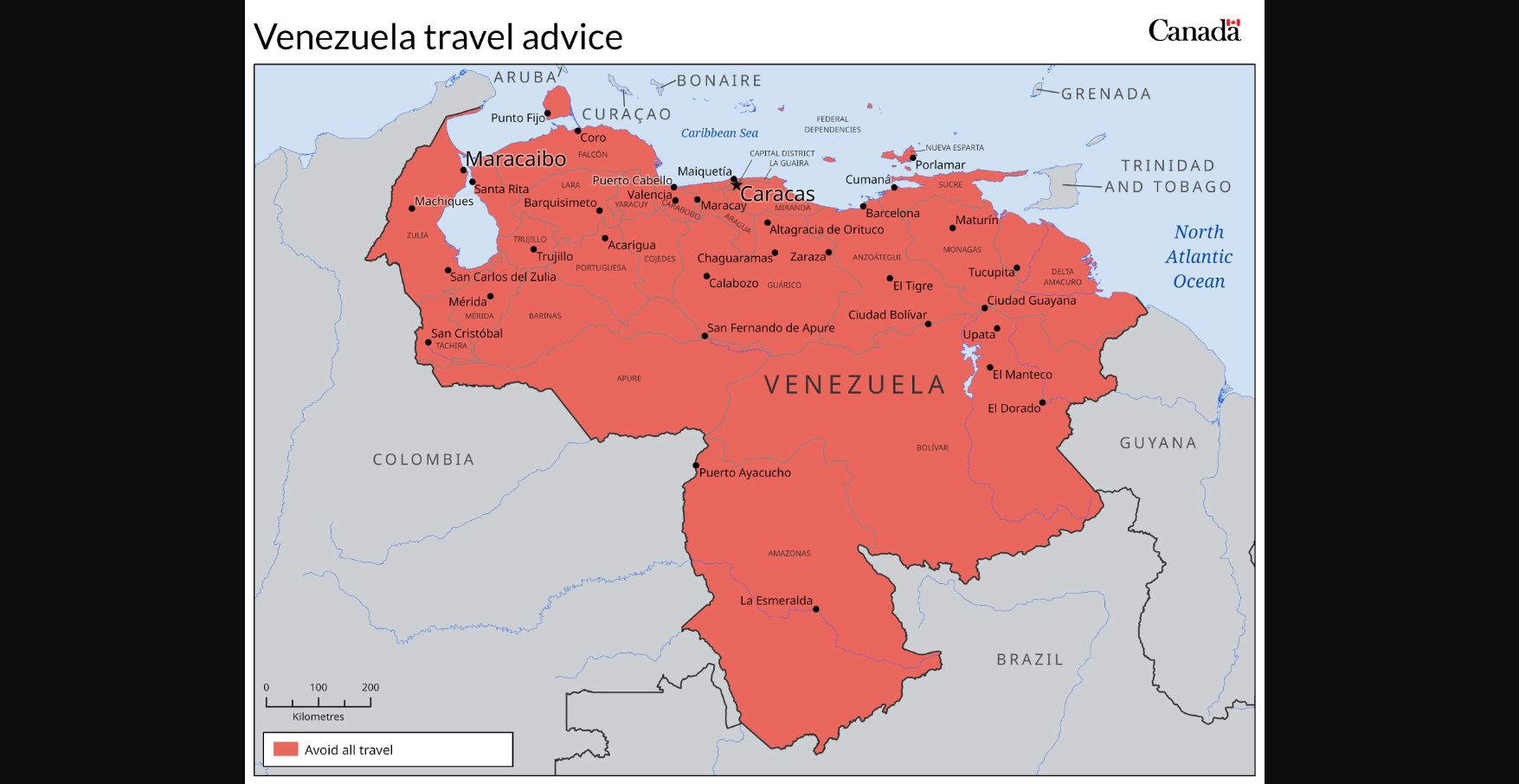
Canada has come out with a new travel advisory for Venezuela in response to what it is calling a “heightened security situation” in that country.
Canadians should avoid all travel to the South American country, due to “the significant level of violent crime, the unstable political and economic situations, the risk of arbitrary detention, and the decline in basic living conditions, including shortages of medication, gasoline, and water,” the advisory says.
“The current situation in Venezuela is tense and could escalate quickly,” it says.
“Borders and airspace could close at short notice.”
The government says several airlines have suspended flights to and from the country.
As well, it says the Embassy of Canada to Venezuela has been closed since 2019, meaning the ability to provide consular help to any Canadians in that country is limited and must be done remotely.
For any Canadians who do choose to travel to Venezuela despite the warning, the advisory says they should:
- Prepare to shelter in place and ensure sufficient supply of food, water, and other essentials;
- Monitor the situation closely, through both local and international media; and
- Register or update your contact information with the Registration of Canadians abroad service in order to receive the latest information from the Government of Canada.
Airport warnings:
The advisory says Simón Bolívar International Airport in Maiquetía (Caracas) is dangerous.
“Incidents of violent crime occur frequently, both inside the facilities and in the surrounding areas,” it says.
“Kidnappers and armed robbers have targeted foreigners, who are assumed to be holding large amounts of foreign currency. Criminals often approach tourists at the airport and offer to exchange money.”
It warns that criminals may also pose as taxi drivers.
Border areas:
Guyana: The border between Venezuela and Guyana is a volatile area due to an ongoing dispute over the Guayana Esequiba region. Anyone travelling in this area should avoid discussing the dispute and exercise caution at all times.
Colombia: The Colombia-Venezuela border is dangerous due to armed criminal groups involved in smuggling, drug trafficking, and black market sales. As well, there is a large military presence, with a high risk of extortion and kidnapping.
Brazil: Smuggling and drug trafficking are concerns along the Brazil-Venezuela border.
Crime:
The Canadian government says there are risks of violent crime, kidnapping, fraud, spiked food and drinks, shortages, and service disruption in Venezuela.
“Venezuela has one of the world’s highest homicide rates,” it said.
“Express kidnappings are frequent and can occur anywhere in the country. Victims are usually kidnapped from the street and forced to take the criminals to their houses to give foreign currency, electronics, or other valuables.”
U.S. issues travel advisory
Meanwhile, the U.S. government has also issued an advisory.
“Do not travel to or remain in Venezuela due to the high risk of wrongful detention, torture in detention, terrorism, kidnapping, arbitrary enforcement of local laws, crime, civil unrest, and poor health infrastructure,” the U.S. advisory says.
“All U.S. citizens and Lawful Permanent Residents in Venezuela are strongly advised to depart immediately.”
The Canadian government posted the updated advisory Jan. 3, after military strikes on several sites in Venezuela, including military facilities, in the city of Caracas and the states of Miranda, Aragua, and La Guaira.