Local News
historian offers a fresh, nuanced look at Canada’s prime ministers, from Macdonald to Carney

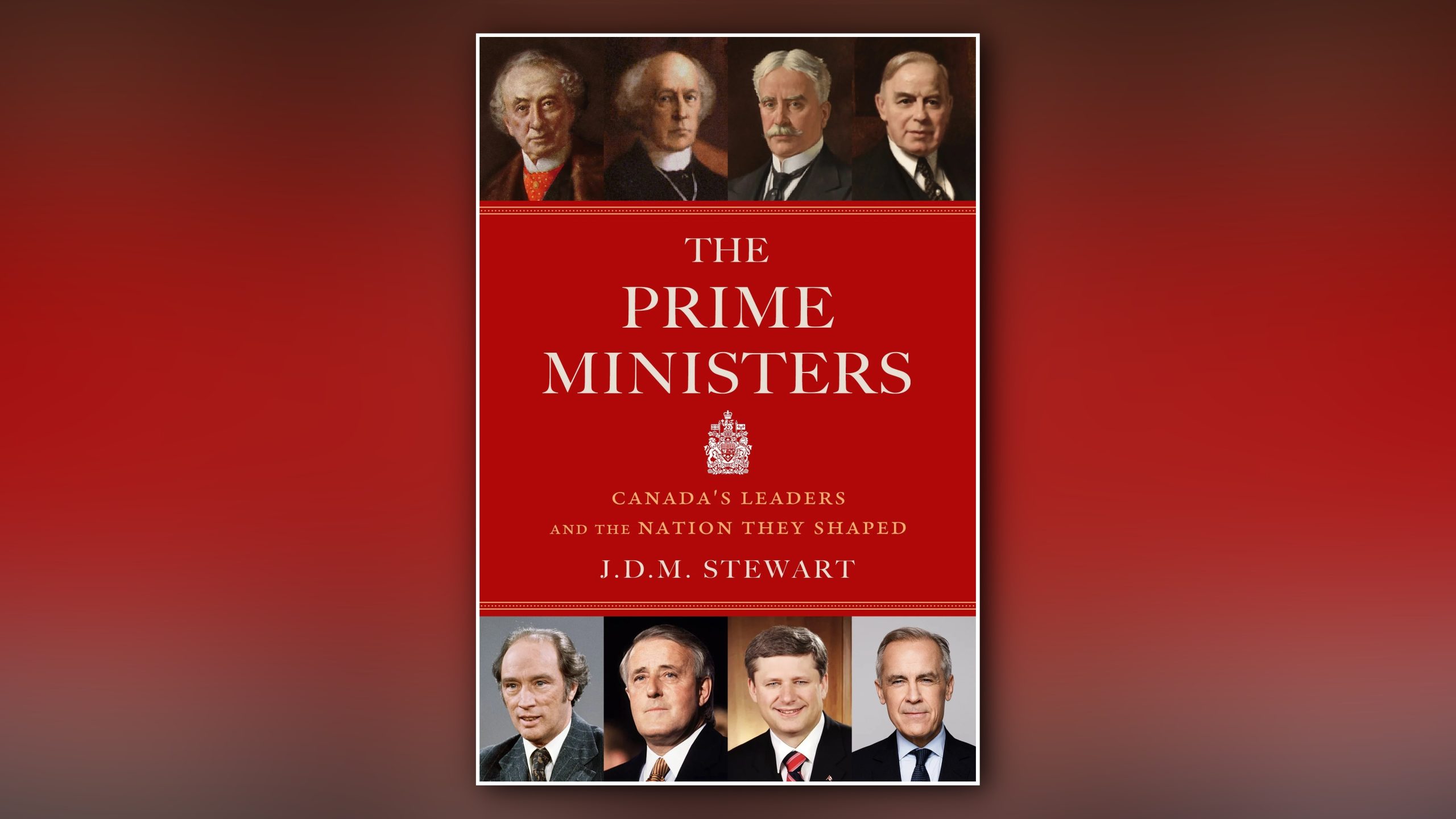
Quick, how many prime ministers can you name? It should be an easy question to answer, but, these days, for many younger Canadians, it is not. Award-winning educator, writer, commentator, and public speaker J.D.M. Stewart learned that the hard way while giving a presentation to classroom full of students. Afterwards he was told, “No one really teaches about prime ministers anymore.” Well, not if he has something to say about it! That simple exchange inspired The Prime Ministers: Canada’s Leaders and the Nation They Shaped – Stewart’s second and latest book.
He came up with the idea while giving a presentation about Prime Minister Lester B. Pearson when he realized none of the students had heard of the Nobel Peace Prize winner.
“So, in front of this group of really knowledgeable model United Nations kids, I asked them who was on my screen and the screen was labelled with Pearson’s name, but they didn’t know who he was. And I was a bit surprised by that. I ended up speaking to the teacher afterward, who said, ‘Yeah, we don’t really teach prime ministers anymore,’” he explained.
“I had spent 30 years being a history teacher, and I certainly taught prime ministers and so, I was a little concerned. And, I thought, I’ve got to do something about this. So, I decided to write a new book, a new interpretation, a new history of Canada’s prime ministers.”
Stewart notes it had been a quarter century since someone had written such a book.
“And so, it was time to get a new book and a fresh interpretation for people to brush up on their prime ministers or be introduced to them for the first time.”
And they’re all there, from Sir John A. Macdonald right up to Mark Carney. Perhaps most valuable, is a detailed bibliography that invites further reading.
Of course, our views on history have changed a lot in the last quarter-century. And perhaps no prime minister has seen a greater change in how they are viewed than Sir John A. Macdonald.
“When the Truth and Reconciliation Report came out in 2015, we started to take a new look at the history of residential schools, and we know that Sir John A. McDonald had a hand in the beginning of those schools in 1883. A lot of people were really upset by that and were looking for a scapegoat for their anger about what happened to our Indigenous people.”
Statues of Macdonald were defaced, or in the case of one in Victoria, removed entirely. But Stewart says a more nuanced view has emerged since then.
“John A. Macdonald is not the only prime minister who bears responsibility for what happened to Indigenous people in Canada. Every prime minister has had a hand in not fixing the problems or exacerbating them.”
Indeed, Stewart argues context is important, whether you’re talking about 1875, 1975, or 2025.
The evolution in Canadian historiography to reflect Indigenous perspectives has not only affected how we view Macdonald but also the settlement of the country itself, as seen in recent histories of the Hudson’s Bay Company and the Canadian Pacific Railroad.
The book is also forward looking. The last chapter is devoted to Mark Carney, who has only been on the job for a matter of months. Stewart offers advice to the current office holder about not trying to do the job all by himself, especially given the tendency of modern prime ministers to center power in the PMO – the Prime Minister’s Office.
“Mark Carney, I think, if he’s smart, he will distribute some of that power. I’m not so sure that he’s been doing it yet. It is still a bit early to tell, but the concentration of power, being prime minister, you need a strong team behind you regardless. And so, my advice would be finding some really smart people to rely on and use them.”
Stewart says that concentration of power was especially true during Justin Trudeau’s time in office. Many of his former ministers complained about him being remote and inaccessible. There is a growing literature on this contained in the memoirs of Bill Morneau, Jody Wilson-Raybould, Marc Garneau, and, most recently, Catherine McKenna.
Stewart covers the prime ministers chronologically and not in order of importance, but one could rank them based on how much space he devotes to each. The chapter on Pierre Trudeau is the longest, clocking in at 29 pages. In second place is William Lyon Mackenzie King at 26 pages. Brian Mulroney, Sir Wilfrid Laurier, and Macdonald are tied for third at 24 pages. Next up is Justin Trudeau at 22 pages, followed closely by Jean Chretien at 20 pages, and then Stephen Harper and Lester B. Pearson are tied for ninth place with 19 pages each. John Diefenbaker rounds out the top 10 at 18 pages.
On the other end of the scale, you have Sir John Abbott, Sir John Thompson, Sir Mackenzie Bowell, and Sir Charles Tupper, the four prime ministers who followed Macdonald, all sharing a chapter as do Joe Clark and John Turner.
Stewart makes a special exception for Kim Campbell, who was briefly prime minster between Mulroney and Chretien.
“I left Kim Campbell in a unique chapter of her own, and I know she only served as prime minister for about 120 days or so, because she was the country’s only female prime minister,” he said.
Ultimately, the book is a spirited defense of why we should continue learning about our prime ministers.
“There’s an aversion to teaching leadership and political history because, in many cases, it involves white men, and that’s been frowned upon,” he said.
“But we can’t really do anything about the past when the history of our prime ministers is 23 men and one woman. I think regardless of whether they’re white or brown or Indigenous, whatever the case may be, they are the person who occupied the office, and we should be teaching what happened in that office.”
At a time when Canadians are asserting their national identity in the face of threats of annexation from south of the border, Stewart says real sovereignty begins with understanding your country and your history.
“And this book [helps do that] in an entertaining and interesting way. You’re not going get bogged down in heavy details. You’re going to have a nice general romp through the great events of Canadian history and the people who were leading us.”
Hopefully, by the end of it, more young people will have heard of Lester B. Pearson too.
The Prime Ministers: Canada’s Leaders and the Nation They Shaped is published by Sutherland House.