Local News
Unknown if police officers will testify at hearing into death of Myles Gray: OPCC

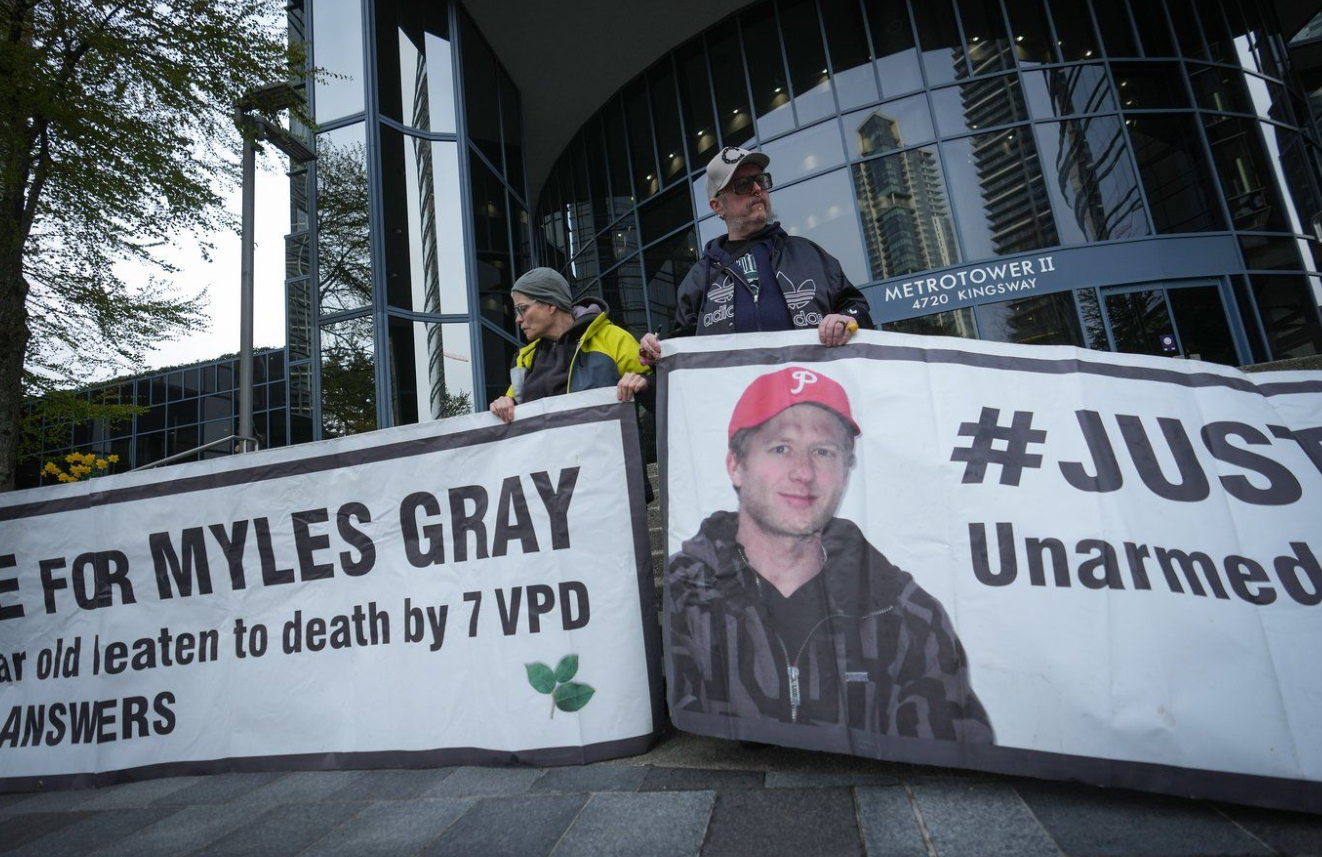
It is not yet known whether a public hearing into the death of Myles Gray will include testimony from a group of seven Vancouver Police Department officers involved in the fatal confrontation in Burnaby, B.C., in 2015.
Brian Smith, general counsel for the Office of the Police Complaint Commissioner of British Columbia, told a briefing on Thursday that officers involved in public hearings called by the commissioner can’t be compelled to testify.
Several other officers who attended the scene of Gray’s death as well as paramedics and a pathologist are among the witnesses set to testify at the hearing starting next week in Vancouver.
Gray, who was 33, died after a beating that left him with injuries including ruptured testicles and fractures in his eye socket, nose, voice box and rib.
A discipline authority cleared the seven Vancouver officers of wrongdoing in October 2024.
But police complaint commissioner Prabhu Rajan said there is still “meaningful uncertainty as to what happened.”
In the notice of public hearing issued in December 2024, Rajan said the discipline authority dismissed allegations of misconduct against officers Kory Folkestad, Eric Birzneck, Derek Cain, Josh Wong, Beau Spencer, Hardeep Sahota and Nick Thompson.
Still, the notice said the decision by Delta Police Chief Neil Dubord — who was appointed to look into allegations of abuse of authority and neglect of duty against the officers — noted the procedural framework for discipline proceedings under the Police Act are “strangely lopsided.”
“For example, the Act allows respondent members to choose who can testify. In this case, witnesses with potentially relevant evidence were not called to testify,” the notice said.
“The discipline authority had to decide the case despite having identified discrepancies and inconsistencies in statements made by (Vancouver Police Department) members and limits in the evidence before him.”
Rajan said Gray’s family asked for the public hearing, and retired B.C. Supreme Court Justice Elizabeth Arnold-Bailey has been appointed to preside over it.
Smith said Thursday that the Police Act allows officers named as respondents to choose whether they testify at a public hearing, though an adjudicator can draw an “adverse inference” from an officer’s failure to testify.
“The respondent officers may choose to testify or they may not, and that will be for them to decide,” Smith said.
The schedule shared in advance of the hearing lists the first witness as Margaret Gray, the mother of Myles Gray, followed by three civilian witnesses who saw the man before his fatal interaction with police on Aug. 13, 2015.
The schedule for the 10-week public hearing remains tentative and subject to change on short notice, Smith said.
Ian Donaldson, a lawyer for the Gray family, said in October 2024 that the disciplinary process for police misconduct was “flawed and imperfect and incomplete,” since it didn’t consider key evidence from a 2023 coroner’s inquest into Gray’s death.
The inquest jury recommended the implementation of police body cameras as well as improved training on de-escalation techniques and how to reduce risks to people “exhibiting a mental health disturbance.”
The inquest findings detailed how Gray had been at a business on Marine Way near Boundary Road on the day of his death, and he was seen walking away from his truck, in which he left his wallet, keys and backpack.
Gray was reported missing to the Burnaby RCMP by his parents, while witnesses reported seeing him acting erratically not far from where he abandoned his truck.
The inquest verdict said Gray approached a woman in her front yard while she was watering plants with a garden hose, which he took from her, using it to spray her.
The woman’s son testified that Gray, who was shirtless and shoeless, appeared to be “intoxicated and/or having mental health challenges.”
A responding officer found Gray near the intersection of Southeast Marine Drive and Joffre Avenue, and after speaking with him, she testified that he became aggressive. She called for backup before Gray ran up a set of steps to a home.
A struggle ensued, with police testifying that Gray exhibited “superhuman strength.”
Several officers testified that Gray was behaving in an “animalistic” way, and he didn’t appear to feel pain as they hit him with their batons and knees, punched him in the face and wrestled him to the ground.
Dr. Matthew Orde, the pathologist who performed the autopsy on Gray, told the inquest that extreme physical exertion during the struggle with police to restrain him was among a “perfect storm” of factors that led to his death.
Orde testified that Gray died of a cardiac arrest complicated by police actions, specifically “neck compression,” blunt force injuries, pepper spray, and officers forcing Gray onto his stomach before he was handcuffed.
“I think these issues would be enough to tip him over the edge,” Orde told the inquest.
This report by The Canadian Press was first published Jan. 15, 2026.